
Theological Method: An Introduction
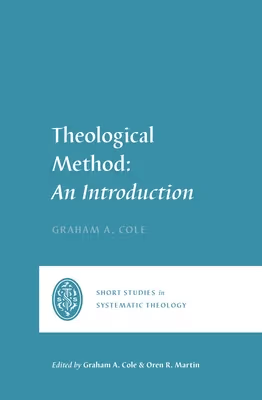
Cole, Graham A. Theological Method: An Introduction. Wheaton: Crossway, 2020. 2025. $16.99. Softcover, 118 pp. ISBN 9781433580819.
To the beneficial list of books Dean Don Payne recommends to our incoming students, I would add Cole’s short volume on (evangelical) theological method. Cole achieved his goal of writing, “simply…not simplistically” (p. 17). In particular, I would suggest that students who have little or no theological background peruse the book. I think taking a few hours to read it will prove eye- as well as heart- and mind-opening. Theology should not be a merely “intellectual” enterprise; theology, properly done, should result in and be worship (p. 101). Cole explores how the Bible can be doctrinally codified in five steps. These steps, taken as chapters, are the building blocks of theology ‘done right’ (p. 17).
The first step/chapter concerns the Bible itself, “the word of revelation” (p. 18). At least for “evangelical” theology, we find the basis for our doctrines in the God-breathed pages of Scripture. “Scripture is the Spirit-inspired, inerrant, and infallible crystallization of the divine discourse” (p. 20). Cole succinctly defines inspiration, inerrancy, and infallibility before turning to what distinguishes evangelical from liberal theology. The distinction regards authority. “Scripture in the norma normans (norming norm)…the norm by which theological proposals are to be tested” (p. 24). Jesus certainly thought that this was so, as he demonstrated in his interactions with Satan, the Sadducees, and the Pharisees. Jesus appealed to the authority of the Old Testament. Moreover, Jesus recognized that Scripture can be misinterpreted. Thus, Cole has a brief discussion of hermeneutics. He also helpfully distinguishes “espoused theology” from “operational theology” (p. 32). Cole makes the salient point that what we believe about God should dictate how we live. Reading the biblical text ought to be transformative. Before he concludes the chapter, Cole examines the doctrine of the Trinity as a possibly “textless doctrine” (pp. 35-37). Trinity is not a biblical term, but the concept is thoroughly biblical. It is not “textless” because it gives a single designation to overlapping formulations about God: “oneness, threeness, substance, persons, inseparability, and distinctness” (p. 37). As we interact with God’s word, it transforms us, and our theological categories inevitably thicken.
Although Scripture is the basis, “our touchstone,” for evangelical theologizing, we are situated creatures (p. 39). We are both temporally and locally situated, so good theology needs to make sense of our global past. The second chapter, “The Witness of Christian thought and Practice,” considers Christian tradition. If the Bible is the norma normans, Christian tradition is “a norma normata (a ruled norm). For traditions to be worthy to pass down to another generation, they must be biblical, as well as being an expression of God’s heart, his will. We can, and must, learn from both good and bad traditions (p. 41). The Pharisees give us examples of traditions that obscure, if not undermine, a revelation of God’s heart. Paul, in handing down what he had received from the first Apostles and Jesus himself, gives us examples of good traditions that rehearse the Gospel message. Church history, by offering many traditions, good and bad, aids the thoughtful, prayerful theologian in recognizing the worthy ones. Cole notes, too, that controversies have helped shape our theological traditions. The Nicene creed (AD 325) was formulated to counter the Arian belief that God, the Son, is not “‘of one being with the Father’” (p. 45). If Arius were correct, Jesus could not be a legitimate object of worship, making a mockery of Rev. 5:12, “‘Worthy is the lamb who was slain to receive power and wealth and wisdom and might and honor and glory and praise”’ (p. 46). In this context, another extra-biblical word arises, homoousios (same essence, or substance). Should a term unused in the Bible be predicated of God, the Son? Cole would aver; “sense and terminology need to be distinguished” (p.48). He goes on to point out that if this were not the case, there could be no valid translations of the Bible. Equally germane is the fact that Arian and other anti-trinitarian beliefs are still held. There is nothing new under the sun; most new heresies are reworked old heresies. Sola (only) Scriptura need not entail nuda (bare) Scriptura; that is, Scripture alone is the final arbiter of doctrine, but many voices, including those of Church traditions, should be heard in the arbitration. Santayana’s oft-quoted caution concludes the chapter, “‘Those who cannot remember the past are condemned to repeat it’” (p. 52).
In chapter 3, “The World of Human Brokenness,” Cole revisits our situatedness. We are, indeed, east of Eden. Our theology must reckon with our fallenness. But, as all creation groans for redemption, Christians have a solid hope. Since Jesus conquered sin and death in his resurrection, we find ourselves “‘in the last days,”’ the age which will culminate with the second coming (p. 58). With such hope, “the human imagination…enables us to transcend our own times” (p. 59). Cole asserts that theologians who are humbly aware of their own limitations, who are teachable, need to practice their craft with input from others (pp. 60, 67). “Theologizing in fellowship with others adds wisdom and depth to our theology” (p. 61). Having established a sound reason for hope, Cole reminds his reader that these “last days” are characterized by war. Satan has yet to admit defeat, so we live in a supernatural war zone in which good battles against evil (p. 62). At this point, Cole returns to fellowship, specifically to the relational aspects of the Trinity. “Relationships are at the heart of reality and always have been” (p. 66). Theologians need each other, and the rest of Christendom, in this broken world between the ages.
Wisdom, the biblical, Spirit-given, practical sort, is the topic of the fourth chapter. Without wisdom it would be impossible to comprehend how revelation, Christian tradition, and our fallenness are interrelated. Wisdom, according to Cole, along with presupposing a “fear of the Lord…involves an activity of both acute and astute observation” (p. 69). He goes on to define theological wisdom as “reasoning,” which only “persons” can do, in the service of the Bible (p. 70). Moreover, reasoning and our discernment of what is true are moral facilities (p. 71). Though sin has marred human thinking, we remain capable of logic. “Sin causes not a cognitive disability but an affective disinclination to trust in God, honor him, or give thanks to him (Rom. 1:21)” (p. 72). Jesus was a master logician in complete obedience to his Father; he was supremely wise. Jesus also understood “dogmatic rank” (pp. 76-78). He could justly accuse the scribes and Pharisees of abandoning the intent of the Law while scrupulously observing certain of its tenets. Cole poses this question when evaluating dogmatic rank, “What is lost if a particular conviction is removed from our beliefs” (p. 77)? From rank, Cole turns to imagination. What is unimaginable may still be conceivable. For example, the Trinity cannot be visualized, but the concept is coherent (p.79). Adjacent to rank is the notion of “control beliefs” (pp. 80-81). Control beliefs are at our core and determine what other beliefs we might accept or reject. Reading and thinking about “Scripture canonically” and contextually (literary and historical) produces wise control beliefs (p. 81). Wise theology is biblical, rational, and livable (p. 82).
As mentioned above, wise, Scripture-based theology that is responsive to our shared Chistian past and cognizant of our human brokenness should be worshipful. “The Way of Worship” titles the fifth chapter. Worship extolls the unsurpassed worth of God. Thus, Cole prompts us to examine our practices, the spiritual disciplines we embrace. He affirms that godly “character” produces godly “insight” (p. 88). In what he calls “‘the Chalcedonian way,’” Cole apprises us that worshipful theology requires boundaries, and those boundaries must be drawn in response to the Bible (p. 91). Clear, scriptural propositions are to be considered as solid boundary lines, where direct implications, inferences, and speculations, in that order, may be held more loosely. Christians ought to be able to amicably disagree from the level of inferences on down. With clear boundaries drawn, Cole explores the Trinity again. Given biblical statements about God (listed on pp. 93-94), Trinity is an orthodox doctrine. Trinity is also essentially relational; the coinherence of the three Persons of the Trinity forms an other-centered community (p. 96). This fact has many and multifaceted implications for the Christian life. In Romans 12:1, Paul exhorts us to offer ourselves wholly to God because such sacrifice is our “reasonable service,” or rational/logical worship (λογικὴν λατρείαν) (p. 100). He continues with two imperatives; one is negative “do not be conformed to this age,” and the other is positive, “be transformed by the renewing of your mind” (Rom. 12:2a). With renewed minds, we can “test so as to approve what is the will of God”; that is, we can do theology aright (Rom 12:2b). “Doing theology…is a way of loving God with our minds” (p. 105). If we love God, we must necessarily love others in mind and action.
Elodie Ballantine Emig
Professor of Practice, NT Greek
Denver Seminary
January, 2025