
New Testament Textual Criticism for the 21st Century: A Practical Guide
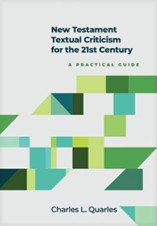
Quarles, Charles L. New Testament Textual Criticism for the 21st Century: A Practical Guide. Peabody: Hendrickson Publishers, 2025. $39.95. Hardcover, 200 pp. ISBN 978-1-4964-7627-2.
With the dawn of the digital age, the field of NT textual criticism has undergone its own revolution in recent years. Many of the prevailing categories and procedures from Tischendorf onward are now undergoing thorough revision as nascent methodologies and technologies emerge which allow for deeper study of the earliest biblical witnesses, a depth of study which was simply unafforded to prior generations of researchers.
A quarter of a century into the third millennium, Charles L. Quarles offers students of the NT a fresh appraisal of the state of play in the specialized field of textual criticism. In New Testament Textual Criticism for the 21st Century: A Practical Guide, Quarles takes the reader by the hand in order to introduce and assess the methods, sources, and tools available for text-critical research. It is difficult to conceive of a more comprehensive, accessible, and concise handbook than what Quarles has produced in this slim volume.
The work is divided into three sections – Part One: An Introduction to Textual Criticism, Part Two: The Method of Reasoned Eclecticism, and Part Three: The Practice of Reasoned Eclecticism.
In part one, “An Introduction to Textual Criticism,” Quarles raises the need to recover the “initial text” (p. 5) of the earliest witnesses. He then surveys the primary sources of evidence at the student’s disposal (papyri, majuscules, minuscules, lectionaries, early versions in Syriac, Latin, and Coptic, as well as the writings of early church fathers). From there, he explicates the two primary approaches employed by textual critics – the Majority Text (MT; not to be confused with “Masoretic Text” in OT studies) and “reasoned eclecticism.”
In the former approach, the “majority rules” since the original text is conceived to be found across the consensus of extant manuscripts. In the latter approach, the one for which Quarles is an advocate, critics generally prefer earlier readings based on “transcriptional evidence” and “intrinsic evidence” (categories which he expounds further in ensuing chapters). He next names tools at the researcher’s disposal, including familiar ones like the Nestle-Aland Novum Testamentum Graece (NA28) and the United Bible Societies’ Greek New Testament (UBS6), as well as perhaps less familiar ones like the Editio Critica Maior (ECM) which is itself based on the Coherence-Based Genealogical Method (CBGM; see Wassermann and Gurry, 2017), the Institute for New Testament Textual Research (INTF), the Center for the Study of New Testament Manuscripts (CSNTM), and the International Greek New Testament Project (IGNTP) among others.
In part two, Quarles provides the process by which reasoned eclectics identify and weigh variant readings based on the nature of external and internal evidence. Most helpful for the purpose of assessing external evidence is his modified position to the hard and fast rule to “Prefer the reading attested by the oldest manuscripts” (p. 52). He offers instead a modified position which prioritizes provenance without capitulating to sheer dating alone at the expense of acknowledging the number of known copies. For evaluating internal evidence, Quarles highlights some of the more common intentional and unintentional amendments introduced by ancient scribes (pp. 78-84). Many of these he helpfully identifies as “a scribe’s text-critical decisions” rather than simply labelling them as errors or even changes (p. 85). The process he presents for evaluating both forms of evidence is nothing if not thorough (fitting for a methodology which has aptly been called the “chemistry of biblical studies”). And the questions he proposes in pp. 85-95 form the basis for part three.
Part three is really three case studies of three example texts: Matthew 16:2b-3, John 1:18, and Colossians 1:12. As a well-established Matthean scholar (see his multiple commentaries on the first gospel, most notably in the EGGNT and EBTC series), the majority of his biblical references are to this book (as well as Mark and Luke) so example A (Matthew 16:2b-3) is the strongest of the sample texts, in my view. But all three provide persuasive arguments for readings at odds (or in qualified agreement) with the consensus arrived at by the editorial committees of the NA, UBS, and SBLGNT editions.
The book concludes with four appendices including a user-friendly guide to assessing variant readings (following the steps outlined by Quarles in previous chapters), a list of Greek church fathers, problems with the text-type approach, and his account of “thoroughgoing eclecticism.” The remarkably useful glossary of terms for this jargon-laden field of research and the bibliography alone are well worth the price of purchase.
It is hard to know for sure who the intended audience is for this edition. In some ways, it would have been better suited for classroom use if it included discussion questions, practice exercises, and a deeper application of how to employ digital tools on Logos and Accordance (softwares which most NT scholars are more likely to engage on a regular basis than the INTF or IGNTP pages). The volume could have benefited as well from the inclusion of full-color images of the most textually significant witnesses (e.g., 𝔓46, Sinaiticus, Alexandrinus, and Vaticanus). But these are likely publisher decisions which may have copyright limitations.
Given the regrettable decline of introductions to the field of textual criticism in many seminary classrooms and the specialist nature of the work, it makes sense to frame the book for a broader readership (pastors, students, professors, and interested lay people). Each of these groups should benefit immensely in the 21st century (and beyond!) from this valuable addition to the field.
Hunter P. Hambrick, M.Div.
PhD Student, University of Edinburgh
March 2026