
Understanding Biblical Law: Skills for Thinking With and Through Torah
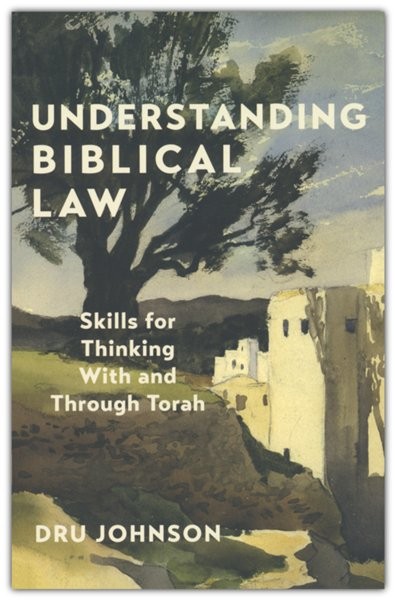
Johnson, Dru. Understanding Biblical Law: Skills for Thinking With and Through Torah. Grand Rapids: Baker Academic, 2025. Paperback, $24.99. 208 pp. ISBN: 9781540967091.
Biblical Law is unlike anything the world has ever seen, either ancient or modern. Its distinct presentation, “legal texts mixed in with narratives, poetic song, and ritual instruction, all intended to be read side by side” (p. 10), demands readers to develop skills that help them to reason with and through such instruction. Johnson’s recent publication equips students of the Bible to meet these demands.
The book begins by orienting the reader to its contents and learning objectives. The content is then divided into three distinct yet progressive parts: “Reorienting to Biblical Law,” “Exploring the Genius of Biblical Law,” and “Thinking with Biblical Law.” Woven through the fabric of this publication is a fictional story, with seven distinct episodes of a potential murder, that demonstrates how the Law might have functioned in ancient Israel.
The first part, “Reorienting to Biblical Law,” is designed to expose the reader’s current understanding of Law in order to redirect one’s understanding towards Biblical Law. Johnson addresses several inferences and myths that modern readers of the Law have, which are unhelpful. For example, “Biblical Law Does Not Aim at Punishment” (p. 37), so it is not “a List of Does and Don’ts” (p. 51). He then provides alternatives that are more helpful and foundational for the book’s subsequent parts.
The second part, Exploring the Genius of Biblical Law,” engages with the unique presentation of the Laws in the Pentateuch/Torah. The “Genius” Johnson refers to pertains to “innovated modes and methods of literary thinking” that “[play] off the legal norms and social concerns of their day” (p. 84). The authors composed the Law as instruction, “not as rules to BREAK or KEEP” (p. 107). Rather, the Laws were composed for “Principle-and-Instance Reasoning” (p.111). Differentiating between these two kinds of reasoning is essential and it is not always an easy task. For example, some laws are clustered together which, on the surface, do not seem to relate to one another. Additionally, there are “Narrative-Shaped Laws” (p. 126) and “Laws That Shape Narrative” (p. 129). Yet, Johnson, building upon the foundation laid in the first part, walks the reader through select Biblical Laws to demonstrate how to tell the difference.
The third and final part, “Thinking with Biblical Law,” invites the reader to engage with the Biblical Law directly. There are seven opportunities to practice the skills developed throughout the book. These skills are applied to reading laws in their ancient context, in their literary context, and in their theological context. Following each practice, Johnson expands upon the passages engaged with.
Understanding Biblical Law is designed to help the reader learn and develop the necessary skills to read the Law as it was intended, namely as instruction/Torah. The learning objectives Johnson presents at the beginning of his book, five in all (p. 4), can be attained by the reader as engagement with the practices in the third part ensue.
I commend this book to those who are interested in gaining a better understanding of the Law in the Bible, especially how the biblical composition is designed to be engaged with rather than a mere list of 613 laws of dos and don’ts. For anyone who would like to discover a new area where their modern sensibilities may hinder reading, understanding, studying, and interpreting the biblical text, even outside the first five books of the Bible, this book can serve you well. To anyone who struggles to understand how the Law in the Old Testament/Hebrew Bible relates to us in the modern world, within our current political context, this book will help you make that connection because, at various points in the book, there are vivid applications which reach beyond the time of Jesus and the New Testament and arrive in our time in our day.
Jeremy C. Kitto, MA
Denver Seminary
November 2025